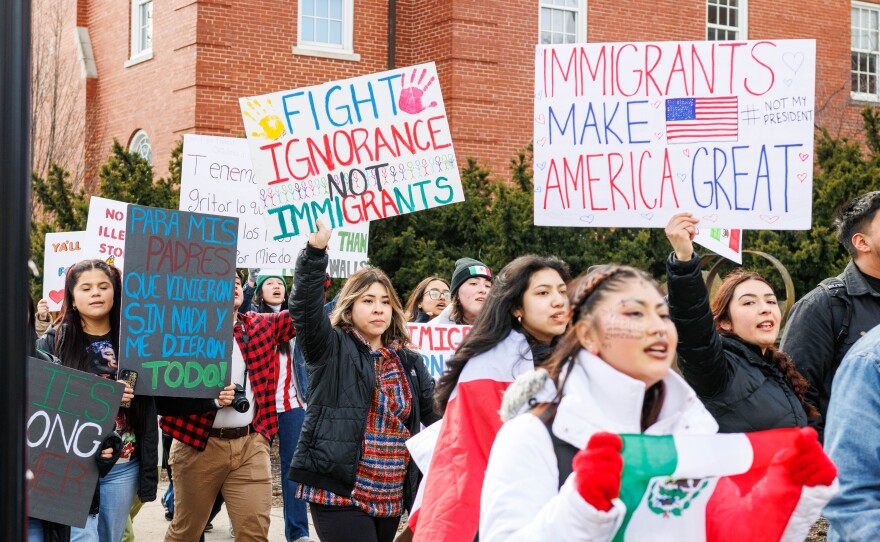
At Odds: The Legality and Morality in the U.S. Immigration System
Introduction
When I was 4 years old, my father left the country and returned to Mexico. My mother was left with two young children and uncertainty as to whether or not he would return. This was because he applied for his residency, and in doing so, he had to admit his illegal entry into the United States. With that, there was a possibility that he would be rejected. I didn’t know what was going on, I just knew that my father was gone.
When I was 8 years old, I began helping my father study for his citizenship test. I spent countless hours a week, making sure that he would be ready for the big day. When I was 10 years old, my father became a citizen of the United States. At the time, I was unaware of the grueling process and as to why my father had to go through all of this. I knew the legality behind it. I just didn’t know why he actually came to the U.S. the first time.
I finally had the opportunity to sit down with my father in April of 2024 and unpack as to why he came to the U.S. in the first place. My father came from a poor family of 11. At a young age he would work with his father in the fields on his days off from school. As the eldest boy, he had many responsibilities. These responsibilities drastically changed on Sunday, August 1, 1993 when he learned that his father suddenly had a stroke and passed away at the neighbor’s house next door. Almost two years later, at age 14, my father decided to leave the only life he ever knew to provide for his family. He packed his bags and crossed the border between the U.S. and Mexico by himself.
Background
Who we know to be immigrants today have been present in the United States since the 19th century. Many came in search of opportunity and freedom, with the largest waves of immigration beginning in 1892 after the opening of Ellis Island (Immigration to the United States). The majority of these immigrants were German, English, and Irish. Immigrants have been discriminated against for quite some time, but this has drastically increased in recent years as immigration has become a polarizing topic. Amidst policy changes and ICE Raids under the Trump 2.0 administration, the morality and legality of the actions taking place has been called into question. ICE raids have been taking place for years, the concern lies in the methods and excessive force being used. ICE agents have “unprecedented interpretations of their legal authorities,” using what they believe to be the law as justification for immoral acts (How ice went rogue, 2026).
“Migrant criminals.” “Illegal monster.” “Killers.” “Gang members.” “Poisoning our country.” “Taking your jobs.” This is just some of the rhetoric spewed by President Trump – Rhetoric that overshadows the accomplishments of hundreds of thousands of immigrants. Rhetoric that disregards the struggles and humanity of people seeking a better life. In the 2016 election, Trump capitalized on fears about cultural and economic threats using immigration as a pawn (Winders, 2016). Word choice plays a large part in how immigrants are perceived which will be a large part of my discussion. Because of my personal relation with immigration, I have consistently felt drawn to the topic and felt the need to unpack why individuals feel the way they do.
The Numbers
We most often hear support for immigrants in terms of moral stances claiming that everyone should have an equal chance. In fact, the only difference between an immigrant and a citizen of a nation is the categorization of their status as a result of where they happened to be born. This categorization is constructed by institutions. Therefore, understanding the topic as a whole requires grappling with both sides of the issue and understanding why people may be against immigration. The most common arguments are presented and evaluated below (Nowrasteh, 2018).
- “Immigrants will take American jobs, lower our wages, and especially hurt the poor.”
Countless studies show that immigrants actually contribute to the economy, and countries with higher numbers of immigrants have faster growing GDP as a result of the taxes immigrants do pay (Immigrants Aren’t Stealing Your Jobs Or Lowering Wages, 2025). In the year 2022, immigrants contributed to taxes, totalling $579 billion (Immigrants Aren’t Stealing Your Jobs Or Lowering Wages, 2025). Additionally, immigrants contribute to the creation of jobs as they fill roles of unskilled laborers that many educated individuals would unlikely fill. In a similar nature, they contribute to an increase in work force entry by fulfilling employment roles that allow for others to enter the workforce (Immigrants Aren’t Stealing Your Jobs Or Lowering Wages, 2025).
- “Immigrants are a major source of crime.”
Immigration is often associated with a public safety threat, however, the numbers prove otherwise. Immigration is not associated with high crime rates. As a matter of fact, many immigrant neighborhoods have low or stable crime rates which can be linked to relationship building within these communities (Graham & Kubrin, 2018). In comparison to U.S. citizens, immigrants commit crimes at lower rates often associated with fears of deportation as well as high levels of workforce participation (Undocumented Immigrant Offending Rate, 2024).
- “It’s easy to immigrate to America and we’re the most open country in the world.”
This statement is often in relation to “coming in the legal way” or going through the “process.” The reality is that the process in doing so is often a lengthy and costly one. Many times, individuals who decide to enter the U.S. do not have the time or money to do so, often due to life or death situations. Immigrating is not an easy decision, so doing so establishes the severity of dire situations. Furthermore, the legal process involves long wait times, sometimes so long that no estimate can be provided (Bier, 2018). This is because there is a high demand for entry into the country that is not being met due to outdated quotas and restrictions on the number of immigrants allowed into the country (Bier, 2028). Restrictions are exacerbated based on country of origin (Bier, 2018).
After understanding what the anti immigrant argument entails, the question of where these ideas come from rises. Despite debunking these claims, why do these ideas persist? To gain a deeper understanding, I analyzed existing literature and conversed with experts as well as individuals personally affected by immigration, including my own personal experience.
The Power of the State in Law and Language
The way in which we categorize one another holds weight in terms of the actual effects in our day to day lives as well as on a larger scale through legislation. Sociologist and Assistant Professor of Latin American Studies at Davidson College, Dr. Oscar Cornejo Casares, discussed the relationship between law and how it shapes everyday life and development. When we hear that something is the law, we are quick to classify it as permissible. However, it is important to note where the permissibility comes from. “The law is not something inherently natural, the state produces it.” In other words, the laws we have in place are socially constructed, yet we value them so highly because “the law has an unquestioned logic” that is intended to “safeguard our rights,” according to Cornejo Casares. In turn, we become complicit in structures that reinforce inequality and capitalize on social differences, resulting in legal violence.
When we typically hear the word violence, we often think of physical harm. However, in terms of immigration, legal violence is a structure that targets undocumented individuals through restrictions associated with categorization based on status, resulting in suffering and affecting daily lives (Menjívar & Abrego, 2012). Because the law often remains unquestioned due to precedent, framing plays a major role in how laws are interpreted. When presented with immigration as a security threat, individuals are more likely to support the laws, despite the results of inhumane treatment (Winders, 2016).
The State does not only play a role in enforcing and establishing laws, but it also plays a significant role in shaping the language that is used when referencing immigrants. “By thinking and naming we make something out of nothing” (Cornejo-Casares, personal communication, April 29, 2026). This is later reinforced by the state of how people are categorized. We often hear the terms illegal, unauthorized, undocumented, etc. However, these terms only stand in the context of the power of the state (Cornejo-Casares, personal communication, April 29, 2026). This is because, without the state enforcing laws on the basis of these terms, the terms would mean nothing. In that case, there would be no undocumented immigrations, they would simply be people moving; “it’s just movement, it’s just migration,” said Cornejo Casares.
The Importance of Language and Stories
Critical/cultural rhetorician and associate professor of communication studies at Davidson College, Dr. Sara Baugh, discussed how rhetoric plays a role in shaping the perception of immigrants as well as the importance of storytelling. Cornejo Casares presented how language is institutionalized and established. Baugh builds on this idea by claiming that rhetoric is reinforced by individuals in power. Those in power with particular beliefs are likely to want their supporters to believe the same. “When you have people in power who do not have the public good in the core of their principles, you need a villain,” stated Baugh. This results in targeting those who do not have the power to fight back such as immigrants. For instance, the words used by Trump like “Migrant Criminals” omits the humane part of the whole story and paints immigrants in a bad light (Winders, 2016). “The language we use is never divorced from the consequence,” and today the consequences directly impact the livelihoods and rights of immigrants (Baugh, personal communication, May 4, 2026).
Despite countless studies analyzing the impact of immigrants on the U.S. and concluding a positive one, “people latch on to stories, they don’t care about numbers if it also supports their preexisting view of the world” (Baugh, personal communication, May 4, 2026. Stories can serve as reinforcers of stereotypes, but they also have the power to challenge colonial perspectives when we give individuals a platform to be heard. With the rise of social media, stories are transmitted at a faster rate. It can serve as a portal of misinformation, shaping attitudes towards immigrants, but it can also serve as a platform for stories to be heard. The problem lies in the selectivity of the kinds of stories that get heard. In January of 2026, pre-schooler, Liam Ramos, was taken into custody by ICE agents (Yan & Alvarez, 2026). Photos of him in his blue hat and distraught expression circulated the internet and produced mass amounts of attention. While this sheds light to the inhumane practice immigrants are victims of, it also reinforces the idea of the “model victim,” according to Baugh. It creates a narrative about what immigrants should look like to be granted human rights and be advocated for while leaving out many simply because they might not get the same emotional reaction from people (Cuppini, 2024). Apart from physical characteristics, immigrants are often divided into good and bad with the use of “family” and “felon” (Stevenson, 2018). While intended to display the humanity of immigrant families, this sorting process has adverse effects on those who do not fit the categories such as teenage boys crossing the border alone (Stevenson, 2018).
Bordering Practices
When we think of borders, we often think of those in physical form such as the border wall between the United States and Mexico. Whilst conversing with Dr. Charlie Geyer, a literary scholar and assistant professor at Davidson college, presented the idea that borders come in many forms. Geyer explained that they can be cognitive or physical and actually trying to define what a border is, is a border in itself. However, borders are often linked with a sort of restriction or premise.
As mentioned, borders go beyond the visible ones, but physical borders are reinforced by cognitive ones (Scott,2021). We are who determine what physical borders look like and are established, and doing so requires cognitive bordering (Scott, 2021). We as humans naturally create borders without realizing it. They are in who we associate with and where we reside. A similar claim can be made about the bordering that ICE has contributed to. “ICE operations are a mass attempt to purge the space of the nation of the non-citizen,” stated Geyer. In this process, ICE has contributed to the “implicit lack of movement to domestic spaces” due to fear of deportation and has diffused the border beyond the wall. They’re in our churches, schools, and homes.
Beyond the fear of deportation being a border, physical and cognitive borders play into how immigrants are included in society, or the lack thereof inclusion. In order for a nation to come into existence, there will need to be a group excluded (Geyer, personal communication, May 1, 2026). This is supported by abjection theory that states that individuals are against what they appear to be a threat and what comes from outside (Kristeva & Lechte, 1982). In the realm of immigration, immigrants appear to be a threat due to rhetoric and fear. Additionally, they come from “outside” which is a border constructed cognitively by individuals and physically by the state. While it is almost impossible to live without borders, “when you eliminate borders, there are no citizens,” claims Cornejo Casares, and the topic of conversation moves beyond status.
Legality, Morality, Humanity
While most of what is occurring in relation to ICE raids is deemed to be legal, ethical concerns arise about the morality of what is actually going on. To understand the extent of the mistreatment of immigrants and their overall experience, one must listen to real life stories. Doing so evokes light on the humanity of these individuals and requires perspective-taking.
Sophomore Liz Corral at Davidson College was determined in providing that light. In Spring of 2024, Corral and friends began the Immigrant Justice Coalition at Davidson College. Their first event involved a rally where students and faculty were invited to speak on any issues revolving around immigration. I was originally invited to attend the event as a photographer, but after hearing others speak, I felt moved and decided to share my experience. Corral began this coalition because she wanted “a place for people to feel safe and talk about immigration on campus.” When asked why she cares, she explained her personal experiences and attributed her caring to the fact that she is a human with emotions. As a matter of fact, this is a sentiment often echoed. “It is hard for me to imagine after having a human interaction with an undocumented person still sustaining this sense of entitlement toward violence,” expressed Geyer. Katherine Marshall, a senior at Davidson College, encourages people to seek out relationships with immigrants since we are more connected than we think to be. Marshall spent a semester studying abroad in Oaxaca, Mexico in a program that focused on border and migration studies. That following summer she worked at Annunciation House in El Paso, Texas where she interacted with immigrants daily and was able to listen to their stories.
Marshall recalls interacting with an Angolan family who had been travelling from Brazil and managed to cross the Darién gap, a journey taking months and full of risk. Upon their arrival to the U.S. border, the family was detained, but because the mother was 9 months pregnant and severely ill, she was dropped off at a hospital. “Maybe they crossed irregularly and were being detained as a family unit and the minute it becomes too complicated for the people detaining them, they get released with no explanation of what’s going on,” stated Marshall. Marshall quickly realized that small details get glossed over in immigration discourse. For example, after the mother gave birth, they tried to figure out where to send the birth certificate. However, they didn’t know where they would be next and they didn’t fully understand the concept and significance of a birth certificate. “It’s all legal but so immoral,” asserted Marshall.
In considering this gruesome process, many are quick to point out the “illegality” in border crossing which overlooks the reason as to why people do it in the first place. Marshall believes that it is the “poorest of poor.” To attest to this, in my fathers situation, he was considered the poorest of the poor. He had to decide between life or death, and in the journey taken on foot and bus, he left with nothing but a change of clothes and a gallon of water. Despite this, he knew he had to do it to even have a chance at life, and in this process he learned a valuable lesson; “Never give up to accomplish what you want, ” he said. The driving force? Hope.
This was a common feeling that Marshall also saw amongst the immigrants she interacted with. Many of them would say “God is my abogado,” translating to God is my lawyer. “I was really struck by the amount of hope and faith people at the annunciation house had,” recalled Marshall. One possible explanation for that may be that for some, it’s either that or nothing which also presents the severity of the situation that these immigrants find themselves in. Additionally, the environment in which immigrants live in at places like annunciation houses involves an iImmense amount of uncertainty and complete lack of privacy” which many on the outside do not see (Marshall, personal communication, April 29, 2026). Geyer reminds us that “humanitarian aid is not the purview of the government,” posing a conflict between the fact that what is taking place is legal but cannot and should not be considered moral.
Conclusion
While I remained open minded throughout my research, I struggled to come upon evidence beyond racism that supported anti-immigration attitudes. Further analysis with experts and affected individuals deepened my understanding of the complexity of the issues and reinforced the idea that immigrants deserve an equal chance at life. This indicates that the legal system is in need of reform to account for bias and increasing in immigrants. Moreover, in this process, I uncovered as to where the perceptions of immigrants come from through the use of law, states, and rhetoric. Within each of these subcategories, there is a moral conflict despite the legality. Knowing this, we have a moral responsibility to dispel the lies and invite conversation. “It takes something terrible to happen for conversations to happen,” stated Baugh. We shouldn’t wait until something bad happens. Those conversations must begin now to ensure we educate ourselves on the reality that is these individuals’ lives. In the wise words of Maya Angelou, “…people will forget what you said, people will forget what you did, but people will never forget how you made them feel,” and these feelings come through interaction and conversation.